Technical vs Commercial Bid Evaluation: Key Differences
When several suppliers respond to an RFQ or tender, the lowest quoted price can be tempting. But price alone does not tell you whether a supplier has offered the right product, met the required specifications, or agreed to the conditions your organization needs.
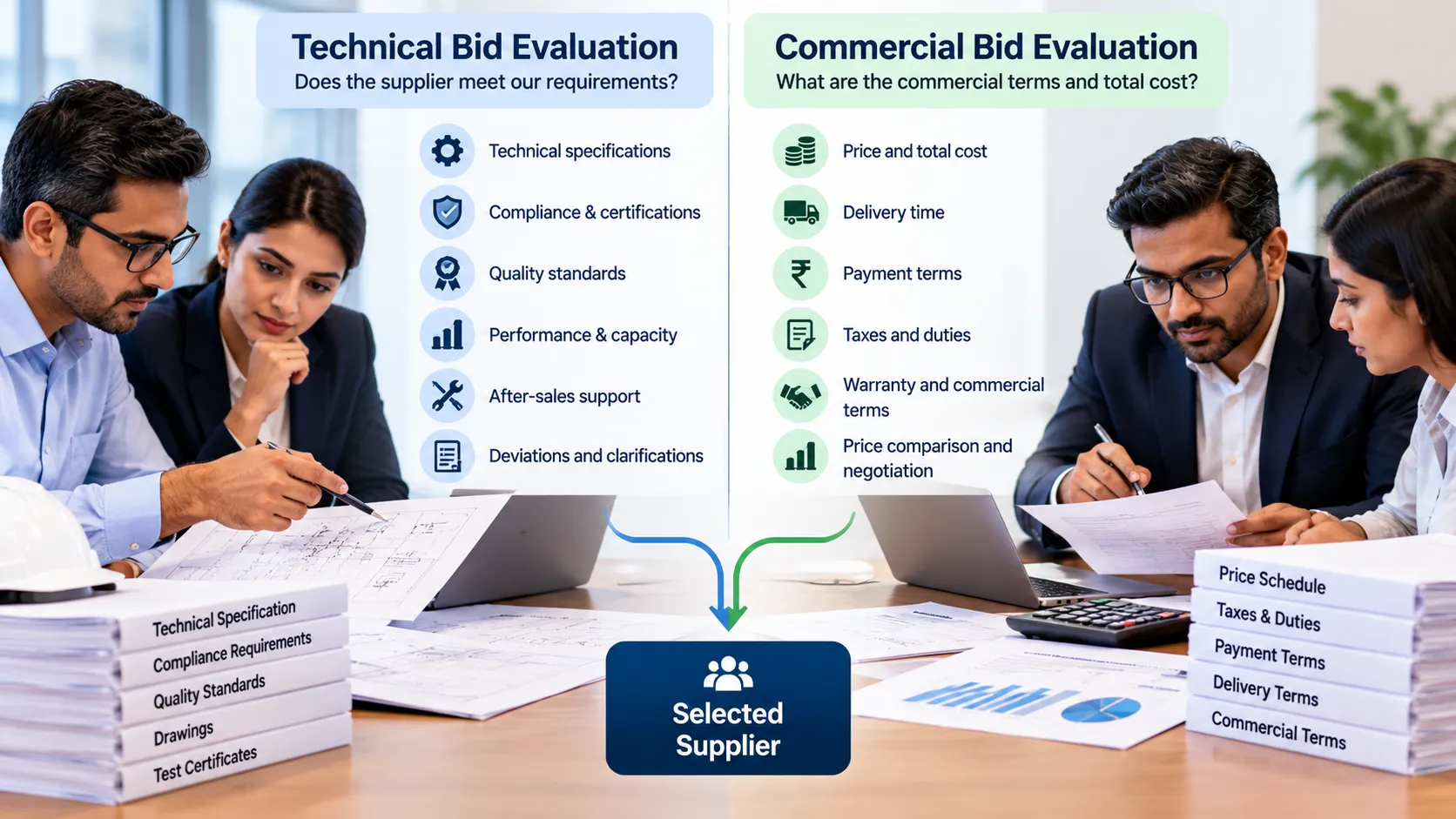
That is why procurement teams commonly separate technical bid evaluation from commercial bid evaluation. The technical review checks whether a bid meets the stated requirements. The commercial review examines price and business terms, using a consistent basis for comparison.
Both matter. A technically unsuitable offer may create quality, safety, or operational problems later. A technically acceptable offer may still be commercially unattractive once freight, payment terms, delivery, and other costs are considered.
This guide explains the difference between technical and commercial bid evaluation, how each stage works, and how procurement teams can make the process clearer and easier to document.
What is technical bid evaluation?
Technical bid evaluation is the review of a supplier’s offer against the technical, functional, quality, and other mandatory requirements specified in the RFQ, tender, or statement of work.
The goal is to establish whether the supplier can provide what the organization actually needs. The evaluation may involve procurement, engineering, IT, quality, operations, maintenance, or other subject-matter experts, depending on what is being purchased.
Typical technical evaluation criteria include:
- Product specifications, dimensions, materials, or performance requirements
- Scope of work and deliverables
- Relevant certifications, standards, or test reports
- Quality assurance and inspection requirements
- Compatibility with existing equipment or systems
- Required capacity, service levels, or operating conditions
- Warranty coverage and technical support requirements
- Implementation approach, where applicable
- Exceptions, exclusions, and missing technical information
The exact criteria depend on the purchase. For example, a manufacturing company buying a machine may need to evaluate capacity, safety features, installation, and maintenance requirements. A company buying a professional service may focus on scope, staffing, experience, deliverables, and service levels.
What is the outcome of technical evaluation?
The result is usually a documented status such as:
- Technically acceptable: Meets the defined mandatory requirements.
- Technically unacceptable: Fails one or more mandatory requirements.
- Clarification required: Information is missing or ambiguous and needs to be resolved under the applicable procurement rules.
Do not treat a missing response as proof that a supplier meets a requirement. Record the gap and follow the organization’s process for clarification or disqualification.
What is commercial bid evaluation?
Commercial bid evaluation examines the financial and commercial aspects of supplier offers. It helps the buying team understand the comparable cost and the conditions attached to each bid.
The goal is to compare offers fairly, using consistent assumptions and the evaluation rules stated for the purchase.
Common commercial evaluation criteria include:
- Unit price and extended price
- Discounts and rebates, where applicable
- Freight, insurance, packaging, and handling
- Installation, commissioning, tooling, or other additional charges
- Taxes and duties, using a consistent comparison basis
- Currency and payment conditions
- Delivery schedule and any associated commercial implications
- Warranty costs or paid support options, where relevant
- Minimum order quantities and price validity
- Price escalation clauses and other commercial conditions
- Total cost of ownership, when it is part of the defined evaluation
A supplier’s unit price may not represent the total cost. One supplier may include delivery and installation, while another lists them separately. Another may offer a lower price but require a large advance payment or have a shorter price-validity period.
Commercial evaluation should make these differences visible rather than treating every quotation as if it included the same things.
What is the outcome of commercial evaluation?
The commercial review produces a comparable financial view of the bids that are eligible for commercial evaluation. Depending on the procurement method, this may include a cost comparison, a ranking, a recommendation, or a record of commercial exceptions.
The lowest evaluated price is not automatically the final award decision in every procurement. The applicable tender rules, technical requirements, risk considerations, approval process, and evaluation method must all be followed.
Technical vs commercial bid evaluation: key differences
| Area | Technical bid evaluation | Commercial bid evaluation |
|---|---|---|
| Main purpose | Check whether the offer meets requirements | Compare price and commercial conditions |
| Main question | Can the supplier meet the defined need? | What is the comparable cost and commercial value? |
| Focus | Specifications, performance, scope, quality, compatibility | Price, discounts, freight, taxes, payment terms, and other costs |
| Typical reviewers | Engineering, operations, quality, IT, technical specialists, and procurement | Procurement, finance, commercial teams, and relevant approvers |
| Common evidence | Technical datasheets, compliance statements, samples, test reports, proposed scope | Quotations, price schedules, cost breakdowns, payment and delivery terms |
| Common findings | Compliant, non-compliant, clarification required | Evaluated total cost, commercial exceptions, price ranking, clarification required |
| Main risk if done poorly | Selecting an offer that cannot meet the requirement | Comparing inconsistent costs or overlooking commercial conditions |
| Key output | Technical evaluation record | Commercial comparison and evaluation record |
The two reviews answer different questions, but they need to use the same RFQ requirements and a clear, documented process.
Example: evaluating three supplier bids
Imagine a company requests quotations for equipment with defined capacity, safety requirements, installation, and delivery conditions. Three suppliers respond.
| Evaluation item | Supplier A | Supplier B | Supplier C |
|---|---|---|---|
| Required capacity met | Yes | Yes | Yes |
| Required safety certification | Provided | Provided | Missing |
| Installation included | Yes | No | Yes |
| Unit price | ₹4,80,000 | ₹4,60,000 | ₹4,70,000 |
| Freight | Included | ₹20,000 | Included |
| Installation charge | Included | ₹25,000 | Included |
| Total before tax | ₹4,80,000 | ₹5,05,000 | ₹4,70,000 |
Illustrative example only. The figures and evaluation conditions are assumptions for explaining the process.
The table shows why the technical and commercial stages should not be mixed together.
- Technical review: Supplier C has not provided the required safety certification. The team must handle that gap according to the RFQ and applicable rules; it should not silently assume compliance.
- Commercial review: Supplier B’s lower unit price becomes a higher total after freight and installation are added.
- Decision: The team should first apply the stated technical eligibility rules, then compare the commercial offers that qualify. The example alone does not determine the final award because the treatment of missing certification and the procurement rules matter.
This approach avoids selecting a supplier based on one attractive number while ignoring a mandatory requirement or additional cost.
How to conduct technical bid evaluation
Step 1: Define the requirements before bids arrive
Write the requirements clearly in the RFQ. Distinguish mandatory requirements from desirable features, and specify what evidence suppliers must provide.
Vague requirements make consistent evaluation difficult. If reviewers interpret the same requirement differently, suppliers may be assessed against different standards.
Step 2: Create a compliance matrix
List each requirement in a separate row and record each supplier’s response. A simple matrix could look like this:
| Requirement | Supplier A | Supplier B | Evidence or notes |
|---|---|---|---|
| Required capacity | Meets | Meets | Datasheets reviewed |
| Safety certification | Provided | Provided | Certificate reference recorded |
| Installation scope | Included | Excluded | Clarification may be needed |
| Warranty period | 2 years | 1 year | Check against RFQ minimum |
Use consistent statuses such as “Meets,” “Does not meet,” and “Clarification required.” Avoid relying on color alone; keep the written status visible.
Step 3: Review supporting evidence
Check datasheets, certificates, test reports, samples, proposed methods, and other evidence required by the RFQ. If a claim cannot be verified from the submitted documents, record what remains to be confirmed.
Step 4: Document exceptions and clarifications
Record the requirement, the supplier’s response, the issue, the clarification requested, and the resolution. Follow the procurement rules for whether and how clarifications can be requested. Do not change evaluation criteria informally after seeing the bids.
Step 5: Record the technical result
Document who reviewed the bid, which criteria were applied, the evidence considered, and the final status. This makes the evaluation easier to explain and review later.
How to conduct commercial bid evaluation
Step 1: Confirm the bids being compared
Apply the eligibility and evaluation rules for the procurement. Where the process requires technical evaluation before commercial evaluation, only the bids eligible under that process should proceed to the commercial comparison.
Procurement procedures differ, so follow the rules applicable to your organization, tender, and jurisdiction.
Step 2: Normalize the cost basis
Make sure the quotations are compared using consistent quantities, units, delivery locations, currencies, and assumptions. Record whether the comparison is before or after tax, and treat discounts and other charges consistently.
Step 3: Calculate the comparable total
Include the relevant cost components, such as:
- Goods or service subtotal
- Discounts applied according to the quoted terms
- Freight, insurance, packaging, and handling
- Installation, testing, or commissioning
- Applicable duties and taxes, based on the comparison rules
- Other costs explicitly included in the evaluation method
Do not assume an omitted cost is zero. Ask for clarification or record the uncertainty according to the process.
Step 4: Compare commercial terms
Review payment terms, delivery commitments, quote validity, minimum order quantities, warranty costs, price escalation, and other conditions relevant to the purchase.
Not every condition can be reduced to a single price adjustment. Record commercial exceptions clearly and escalate material issues to the appropriate reviewer.
Step 5: Prepare the commercial evaluation record
Show the calculation basis, source of each important value, adjustments made, exceptions, and resulting comparison. Have the appropriate person review the calculations before the recommendation is approved.
Common mistakes to avoid
Evaluating price before checking mandatory requirements. A low quote should not override a mandatory technical condition. Apply the stated evaluation process consistently.
Using unclear or changing criteria. Define criteria and scoring rules in advance. Changing the basis after bids are received can make the process unfair and difficult to defend.
Treating missing information as compliance. An empty field does not mean the supplier meets the requirement or that a cost is zero.
Comparing unit prices only. Additional charges and commercial conditions can change the total cost.
Mixing technical and commercial judgments without recording the basis. Keep the criteria clear so reviewers can understand whether a finding relates to compliance, cost, or a commercial exception.
Failing to preserve evidence. Keep quotations, clarification records, calculation assumptions, evaluation notes, and approvals with the procurement record, according to your organization’s retention policy.
Can AI help with technical and commercial bid evaluation?
AI-assisted tools can help with parts of the document-heavy process, but their usefulness depends on the documents, features, and review controls available.
For commercial evaluation, AI may help extract supplier names, quoted prices, quantities, delivery terms, payment conditions, and other fields from supported quotation documents. It may organize these details into a comparison view or highlight information that appears missing or different.
For technical evaluation, AI may help locate supplier statements or identify apparent differences between a bid and a list of requirements. However, it should not be assumed to establish technical equivalence, certify compliance, or make safety-critical judgments without qualified review.
A practical AI-assisted process can look like this:
- Provide the RFQ requirements and supplier quotation documents in a supported format.
- Review the extracted fields and verify important values against the originals.
- Use a structured compliance matrix for technical requirements.
- Calculate commercial totals using explicit, consistent rules.
- Review exceptions with the relevant technical and commercial stakeholders.
- Record the decision, evidence, and approvals.
AI should support the process rather than replace procurement controls. Before uploading quotations, review the tool’s security and data-handling arrangements, especially when documents contain confidential prices or contractual information.
Explore RFQ Quote Compare AI
If your team spends significant time reading quotations and preparing supplier comparisons, explore RFQ Quote Compare AI.
The page introduces our RFQ quote comparison MVP, focused on the supplier quotation comparison workflow. Review the current capabilities and confirm whether they suit your documents and process. The tool should be evaluated on supported file types, extraction accuracy, data handling, and how well it fits your review steps.
It is important to keep technical qualification, commercial calculations, and final approvals under the appropriate human control.
Frequently asked questions
What is the difference between technical and commercial bid evaluation?
Technical bid evaluation checks whether a supplier meets the defined specifications and mandatory requirements. Commercial bid evaluation compares prices, total relevant costs, and business terms on a consistent basis.
Which comes first: technical or commercial evaluation?
The sequence depends on the procurement procedure. Many processes evaluate technical eligibility before comparing commercial bids, but organizations should follow the stated tender rules and applicable regulations.
Can a supplier pass commercial evaluation but fail technical evaluation?
Yes. A supplier may offer an attractive price but fail a mandatory specification or omit required evidence. The procurement team should apply the defined eligibility and clarification rules rather than allowing price to override technical requirements.
What is a technical compliance matrix?
It is a structured table that lists each requirement and records each supplier’s response, evidence, and evaluation status. It helps reviewers apply criteria consistently and document exceptions.
Should the lowest-priced bid always win?
Not necessarily. The result depends on the procurement method and evaluation rules. The lowest quoted price may exclude relevant costs or come from a bid that does not meet mandatory requirements. Follow the stated criteria and approval process.
Can AI automate bid evaluation?
AI may help extract and organize information, compare fields, and highlight apparent gaps. It should not be assumed to validate every technical requirement, interpret every commercial clause, or make the final award decision without appropriate checks.
Final thoughts
Technical and commercial bid evaluation serve different purposes. Technical evaluation asks whether the supplier can meet the defined need. Commercial evaluation asks how the eligible offers compare financially and contractually.
A clear process defines requirements in advance, applies consistent criteria, verifies source documents, records exceptions, and preserves the reasoning behind the recommendation. AI may reduce repetitive quotation review work, but good evaluation still depends on reliable evidence and accountable human judgment.
If you want to explore AI-assisted supplier quotation comparison, visit RFQ Quote Compare AI.