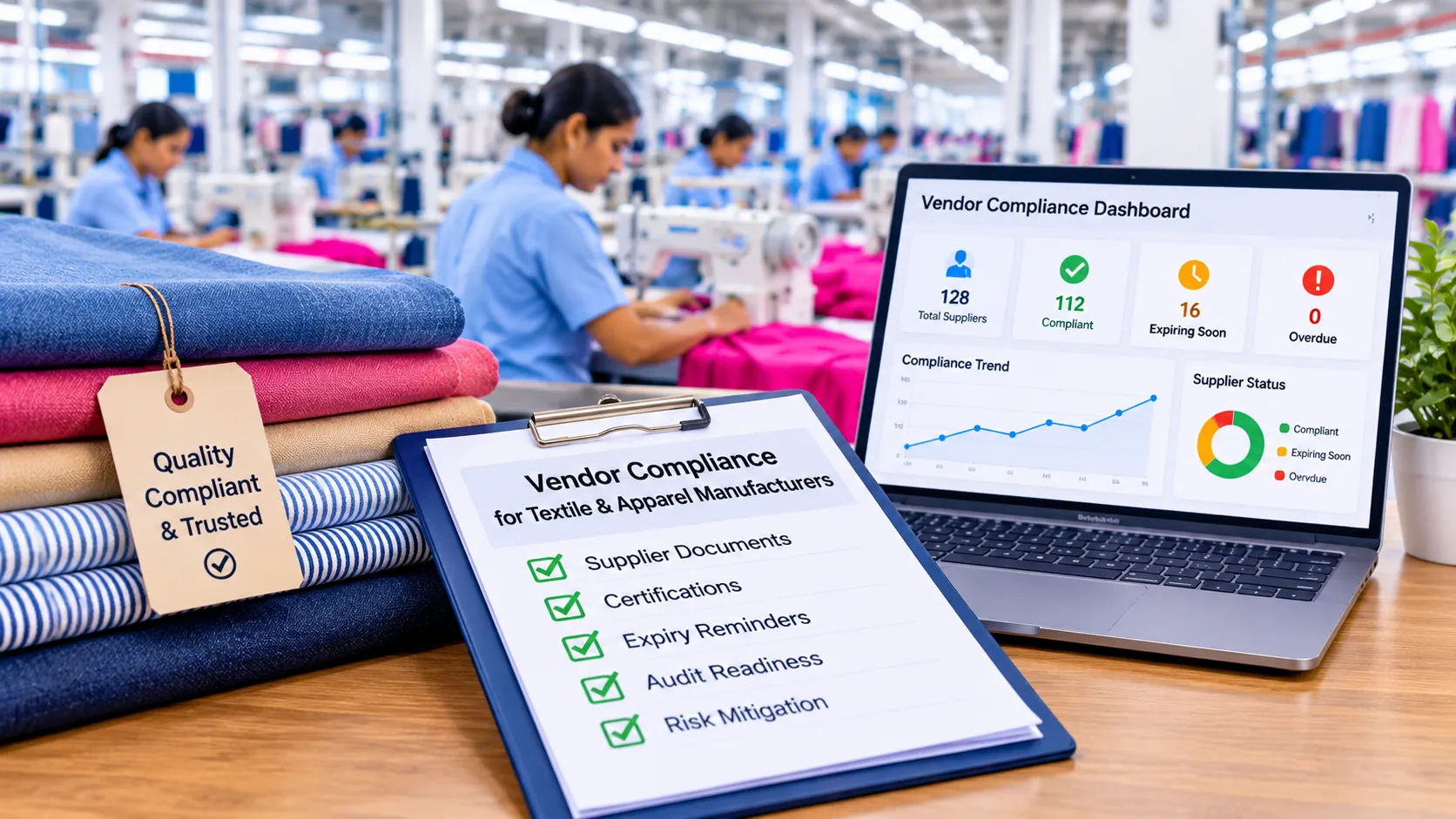
Textile and apparel businesses often work with a broad supplier network: fabric mills, yarn suppliers, dyeing and finishing units, garment factories, packaging vendors, transport companies, and job-work partners.
Keeping production on schedule means coordinating more than materials and delivery dates. Teams may also need to collect supplier documents, check whether records are current, track approvals, and follow up when information is missing.
This gets harder when suppliers change, orders move between facilities, or records are stored in separate spreadsheets and email threads. A missing document may not stop an order immediately, but it can create extra work when procurement, compliance, or a customer asks for the latest records.
A practical vendor compliance process helps textile and apparel manufacturers keep supplier information organized and make follow-up more predictable.
What is vendor compliance in textile and apparel manufacturing?
Vendor compliance means checking that suppliers meet the documentation, contractual, regulatory, and internal requirements that apply to them.
The exact requirements depend on the supplier’s role, the products or services supplied, the buyer’s policies, and the markets served. A fabric supplier may have different requirements from a stitching unit, dyeing facility, packaging vendor, or logistics provider.
Vendor compliance is not the same as inspecting fabric quality or checking garment measurements. Those activities remain important, but document tracking and supplier approvals help teams manage the records associated with their supplier relationships.
Common vendor compliance challenges in textile and apparel businesses
1. Supplier records are scattered across files and email
A team may keep supplier registration details in one spreadsheet, certificates in shared folders, and follow-up conversations in email. When someone needs a complete supplier file, they have to bring these pieces together manually.
What helps: Keep a central supplier register with document type, status, last review date, expiry date where applicable, and the person responsible for follow-up. Use consistent file names and limit access to people who need the records.
2. Documents expire or need review
Some supplier documents have expiry dates. Others may need to be checked periodically or refreshed when company requirements change. If no one owns the review, an outdated record can remain in the system unnoticed.
What helps: Record expiry dates where applicable and schedule reminders ahead of time. For documents that do not expire, define a review interval if your policy requires one. Track whether a renewed or updated document has actually been received and reviewed.
3. Requirements differ across supplier types
Textile and apparel manufacturers may work with spinning mills, fabric suppliers, dyeing and printing units, garment subcontractors, packaging vendors, and transport providers. The same checklist will not necessarily fit all of them.
What helps: Create requirements by supplier category. Mark which documents are mandatory, conditional, or not applicable, and have the relevant teams confirm the requirements. Avoid asking every supplier for every document without considering their role.
4. Subcontracting makes supplier visibility harder
Production may involve job-work partners or multiple facilities. When work is subcontracted, teams may need to understand which organization is responsible for each activity and what checks or records are required under their contracts and policies.
What helps: Maintain accurate supplier and facility details, record relevant subcontracting relationships, and make responsibilities clear. Apply checks based on the actual arrangement and your customer or contractual requirements rather than assuming every subcontractor has identical obligations.
5. Customer requests create last-minute document searches
Buyers may request supplier information or supporting records during onboarding, reviews, or audits. If documents are spread across different locations, staff may spend time searching for the right version and confirming its status.
What helps: Store current records consistently and record important review outcomes. Make it clear which documents are pending, which have been accepted, and which need attention. A structured repository can reduce the time spent assembling supplier files.
6. Follow-up responsibility is unclear
A supplier may have submitted most of the required information, but one document remains outstanding. Procurement may assume another team is handling it, while the supplier waits for clarification.
What helps: Assign an owner and due date to each open item. Track the status of the request and review overdue actions regularly. Simple ownership rules can prevent small gaps from remaining open indefinitely.
7. Manual tracking becomes harder as the supplier base grows
Spreadsheets can work well when there are few suppliers and one person maintains the register. As the supplier network grows, repeated updates, reminder emails, and separate versions of the same file can make the process difficult to manage.
What helps: Review how much time the team spends maintaining records and chasing documents. If the process is no longer reliable, consider a shared system that centralizes supplier documents and automates routine reminders.
How to build a more reliable vendor compliance process
You do not need to change every supplier-management process at once. Start with the parts that cause the most repeated work.
- List your supplier categories. Include the types of suppliers and job-work partners your business actually uses.
- Define the applicable requirements. Work with procurement, quality, compliance, and other relevant teams to confirm which records are required for each category.
- Assign ownership. Decide who collects documents, who reviews them, and who follows up on missing or outdated records.
- Centralize supplier information. Keep supplier details, document status, expiry dates, and open actions in a controlled location.
- Set reminders and review dates. Use expiry reminders for documents that expire and periodic reviews where your policy requires them.
- Track exceptions. Make missing, rejected, expired, and pending records visible, with a clear owner and next action.
- Review the process periodically. Update checklists when customer requirements, contracts, internal policies, or applicable rules change.
The goal is not to create more paperwork. It is to make the records your business needs easier to find, review, and maintain.
Vendor compliance checklist for textile and apparel manufacturers
Use this as a starting point and adapt it to your own supplier categories and requirements.
- List suppliers, facilities, and relevant job-work partners.
- Define document requirements for each supplier category.
- Identify mandatory and conditional documents.
- Record expiry dates where applicable.
- Assign responsibility for collection, review, and approval.
- Track missing, rejected, and pending documents.
- Set reminders for upcoming expiries and required reviews.
- Store current records in a consistent location.
- Record follow-up actions and their outcomes.
- Review overdue items on a regular schedule.
- Update requirements when policies or customer expectations change.
Not every item applies to every supplier. Confirm requirements against your contracts, customer expectations, company policies, and applicable rules.
When should a textile or apparel business consider vendor compliance software?
A spreadsheet may be enough for a small supplier base with straightforward requirements. It becomes harder to rely on when many suppliers have different document requirements, several teams need access, or follow-ups are frequently missed.
Vendor compliance software can help keep supplier records in one place, highlight missing or expiring documents, send reminders, and show which actions are still open. Before choosing a tool, consider how many suppliers you manage, who needs to review records, and which parts of the process consume the most time.
VendorCompliancePro helps teams organize vendor records, monitor document expiry dates, manage onboarding, and follow up on compliance tasks. It supports document tracking and administrative workflows; it does not replace product inspections, technical assessments, social or environmental audits, or legal review where those are required.
Learn more about VendorCompliancePro to see whether a more structured approach could suit your supplier management process.
Frequently asked questions
What is vendor compliance in the textile industry?
It is the process of checking that suppliers meet the documentation, contractual, regulatory, and internal requirements that apply to them. The requirements vary by supplier type and the products or services they provide.
Why is supplier documentation important in apparel manufacturing?
Organized supplier records help teams confirm that required information is available, follow up on missing documents, and respond more efficiently to customer or internal requests. Documentation is only one part of supplier management and does not replace quality or other required assessments.
How can textile manufacturers track document expiry dates?
They can use a maintained spreadsheet or vendor compliance software to record expiry dates, set reminders, and assign follow-up responsibility. The process should include checking the renewed document after it is received.
Should every textile supplier provide the same documents?
No. Requirements should depend on the supplier’s role, the work performed, the buyer’s policies, contractual terms, and applicable rules. Category-based checklists help teams avoid both missing requirements and unnecessary requests.
Is vendor compliance software suitable for small apparel manufacturers?
It may be useful when manual tracking and follow-up become difficult, but it is not necessary for every business. A small supplier base with simple requirements may be manageable in a spreadsheet. The decision should depend on the time spent on administration and the reliability of the current process.
Final thoughts
Textile and apparel manufacturers often coordinate suppliers across several stages of production. When document requirements are unclear or records are scattered, routine follow-up can take more time than it should.
Start by organizing supplier categories, assigning responsibility, and tracking the documents and actions that matter to your business. If spreadsheets and email no longer provide a dependable view of supplier records, a dedicated vendor compliance system may help make the process more consistent.